Category Archives: Resumes

9 Tips for a Killer Cover Letter

Sometimes I get asked by my clients about when it’s appropriate and/or necessary to write a cover letter. The general answer is that it almost never hurts, “almost” being the key word there. Getting a job is all about scoring more points than the next candidate. Lucky for you, it’s really not that hard to win, because many candidates go in with nothing more than an average resume. Everything else that you do above and beyond the typical resume shows that you are polished, prepared, and that you have a real passion for the job you are applying for.
dilbert-urgent

A well-written cover letter scores you more points. A poorly-written, misinformed letter hurts you. Cover letters are especially useful when you are applying for a job with a company that you don’t currently work for. It helps you build a conversational relationship with your hiring manager and helps you highlight the top few things that set you apart from the other candidates.

Here are nine tips to guide you as you write your cover letter:

  1. Keep it short. I can’t emphasize this enough. Long and wordy paragraphs will not get read by your hiring manager. Don’t go any longer than three-fourths of a page. If you can keep it to half a page, even better. Don’t use a small font to cram everything into it to still meet the length restriction. 🙂
  2. Put your contact info at the very top. Just like everything else that you give your hiring manager, it needs to have your name, phone number, and email on it. You want to make it as easy as possible for them to call you at any time.
  3. Be gracious. Be assumptive, but not pushy in the letter. You want your hiring manager to know that you’re very interested in the job, but don’t let it feel like you have a sense of entitlement or that you deserve the job. Let them make the decision. Thank them for taking the time to read the letter.
  4. Introduce yourself. Briefly. Take one or two short sentences to tell them what you’re currently doing. Include your name and job title.
  5. Highlight your top three qualification for this specific job. Quickly state why you’re the top candidate for the position. Focus on the results you’ve achieved, rather than just on the things you’ve done. Use phrases like “I increased online sales revenues by 325% in under six months by integrating A/B testing into our email marketing strategy.” Keep it concise.
  6. Show that you know the company and their industry. This is where it gets a little more difficult. You want to show him or her that you have done your research. Google the company. Read some of their press releases. Find out about their industry. Find out who their competitors and allies are. Try to summarize this briefly in a few sentences. Don’t speak like you’re their next CEO. Just keep it simple and show you’re informed.
  7. Give them a couple suggestions for improvement. This is the most difficult part. It’s a fine line between criticizing and showing that you want to contribute what you’ve learned in the past to their organization. Just be careful that you’re not stating the obvious. If you are not 95% sure that you have a solid suggestion, just skip this section.
  8. Restate that you hope to get an interview. If you’ve shown you have what they’re looking for, you know their company, and you have something valuable to contribute, this part should be easy. Tell them you would love to work with and grow with their company. Tell them you would like to talk more about how you can contribute to their organization.
  9. Sincerely, you. Sign it. Easy peasy.

Cover letters, more than anything else you submit during the application and interviewing process need to be specifically written for each particular job. If you’re applying to a lot of jobs and don’t have time to write cover letters for each one, in my opinion, it’s better to not submit a cover letter at all. If it’s generic, it’s probably not going to get read.

If you would like suggestions or help writing your next cover letter, give me a call or send me a text.
10 Tips for a Solid Resume

Your resume is often your first contact with your potential hiring manager. You need to make it spectacular in order to leave a positive impression. Most hiring managers, myself included, usually only spend about 10 seconds or less on each resume. I quickly scan to see if the candidate has the qualifications that I’m looking for. I’m not necessarily looking for the best candidate at this point. I’m only looking for those individuals that meet my minimum standard for an interview. You have 10 seconds to catch my eye. How are you going to do it?

dilbert-resume

Well, I’ll tell you. Here are ten tips for a solid resume:

  1. Make sure that your name and contact info is easily located. I know, this is just like going back to elementary school, but it happens. Either the name is too small that it gets lost in the text or people leave off important information like their email or phone number. I recommend including at least your email and cell number. Remember that you want the hiring manager to be able to contact you as easily as possible by whatever medium they prefer. Also, make sure you test your phone number and email. I’ve tried to call phone numbers before on resumes that were disconnected. Don’t miss the opportunity because you’ve recently changed cell numbers.
  2. Use a simple file name. 90% of the time you submit your resume through a website or email. That means the first thing the hiring manager is going to see is the file name for your PDF or Word document. Please make sure it’s something professional. I recommend something simple like “Jake Lindsay Resume 2014-03.” This way a hiring manager can quickly search for your resume on their hard drive and it will pop up. If you name it something like “My Resume,” or “Project Management Resume,” or “3-4-14,” it will be lost forever.
  3. Add some color. Don’t go crazy. Find a tactful way to include it to highlight key points like job titles or section headers. It helps guide the hiring manager’s eye to important places on the resume. Most of the resume should still be black and white. It’s easier on the eyes and easier on your printer.
  4. Add a logo. Again, keep it simple. I recommend some kind of watermark or simple logo. The easiest thing to do is use your initials. If you are self-employed or own your own business, you might consider using your company logo. Don’t use someone else’s logo. You’re only giving them free advertising.
  5. Leave some white space. Leave some space on your margins. Your hiring manager will likely have your resume in front of him or her in your interview. Give them some space to take notes so they can remember the awesome things you’ve done.
  6. Create clear section headers. This is where most people go wrong. They try to fit so much onto the page that things tend to get smashed together. Create a clear flow that is consistent throughout the resume. You might consider including lines that go the full length of the page to separate your sections.
  7. Align your acronyms. If you want the best chance of getting an interview, make sure to tweak your resume for each individual job that you apply for. Read the job description several times and circle keywords. Then go through your resume and make sure you have all of the same keywords in easy to find places. The first place to start is acronyms. If they have something like HTML/CSS or PMP on the job description, you better have HTML/CSS or PMP on your resume, preferably in a few different places if you want to get called in for an interview.
  8. Use results language instead of activity language. In reviewing my clients’ resume I often find that their bullet points describe actions that they performed rather than things they accomplished. Managers are looking for people who don’t just go through the motions. They want people who are going to drive results. For example, instead of “Posted content daily on social media accounts” use “Increased likes on company Facebook page from 2,000 to 200,000 through daily posting and frequent review of social analytics.”
  9. Include data points. It’s not enough to say that you’re a team player or have a strong work ethic. Everybody says that. Go the extra mile and prove it to me. Give me some numbers that show how hard you worked. Numbers make your argument more convincing.
  10. Set yourself apart. What makes you different from everyone else? Why should I hire you over the next man or woman? If you look like everyone else, then you’ll end up in the reject pile with everyone else. Take some time to gather a list of your wildly successful projects from past jobs. What are a few assignments that you really knocked out of the park, so much so that your manager told their manager about it? Gather your top three to five WSPs and make sure that they are placed in high-profile places throughout your resume. You might even put them right at the top to catch the hiring manager’s attention. Also consider including any awards you may have received like “employee of the month” that show you have a pattern of excellence.

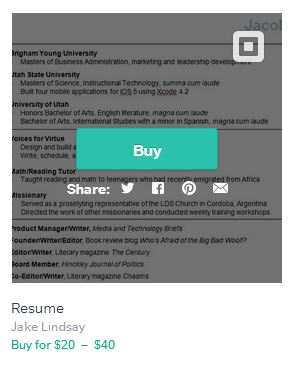
buy-resumeSometimes we get too attached to our own resumes. Don’t worry. I do it too. They are the product of many years or even decades of work. We’ve been adding new bullet points to them each year as we get a new job or finish degrees. It’s almost too hard sometimes to look at them objectively. We tend to miss typos because we’ve read it so many times. Before you apply to any job, make sure to have at least two or three people look it over. One person should be familiar with the industry that you’re applying to work in. One should be unfamiliar with it. That way you can make sure it’s both accessible and targeted. If you’re ready to spice up your resume, let’s talk.

Go from Unemployed to Self-Employed in 60 Minutes

From my experience in my current job as a hiring manager, I’ve seen that it is almost always a bad idea in any interview to say that you are unemployed, or to have a gap on your resume from your last job to now. This tells the interviewer unconsciously that nobody else wants to hire you so they don’t want to hire you either. It’s a steep uphill climb from there.

But…the beautiful thing for you is that it is a very fine line between unemployed and self-employed. It’s your choice to cross that line. No hiring manager can stop you. Saying that you are self-employed always looks better on a resume than unemployed.

square

How do you become self-employed? It’s surprisingly simple. Pick something you’re passionate about that is closely related to the job you’re applying for. Set up a couple social media pages on Facebook, Twitter, etc. so that a hiring manager can find evidence of your business if he or she goes looking for it. Create a blog about your business, write a couple articles, and post links to them on your social media sites. Take 10 minutes to join a website like oDesk.com and start bidding on jobs related to your new business. Set up an account with Square so that you can start taking payments from a mobile device or through your blog. Call your ten best friends and tell them about it. Ask them if they want to be your first clients.

Congrats! You’re now self-employed.

Guess how much this all cost? Zip. You just set up a business for free, and now your getting experience in the job field where you’re trying to get hired, and you can talk about it in your next interview. Pretty cool, huh?

If you’re ready to go from unemployed to temporarily self-employed, let’s talk.

Education: Skate to Where the Puck Is Going to Be

Legendary hockey player Wayne Gretsky said, “I don’t skate to where the puck is now. I skate to where it’s going to be.” You need to take the same mindset about your education.

Think about your next promotion. Have you seen a job description for it? What were the education requirements? If you haven’t seen a job description or the there isn’t one, what is the level of education of the other people in that role?

graduation

For example, there is a job I’ve been looking at for a little while. The job description says a masters degree is preferred. However in meeting with the people in that role, I’ve noticed that most of them have a PhD or an MBA. Regardless of what the job description says, two advanced degrees are the benchmark. Guess what, it’s time to go that degree.

The thing about degrees is that they take a long time to acquire. If you know where you’re headed and what job you want to have a couple years down the road, today is the day to start working on that degree.

What if the interview is next week? Well, do the best you can to represent your concrete desires to seek more education. You can mention that you’ve started your application for a particular program or that you’ve requested additional information from the college. Being accepted to the program is worth more points, as is completing a few semesters. Wherever you are in the program, do your best to represent all the education you have. Time to start that application!

One caveat. It is possible to have too much education. If you’re applying for a promotion, put down as much education as you can. If you’ve been laid off and you’re trying to get back into the entry level positions, you should consider taking your PhD and/or masters degree off of your rĂ©sumĂ© for those applications.

I see many resumes come across my desk for entry level jobs that make individuals look very overqualified. When I see this, I think two things. One, if I give them the job when they’ve become accustomed to a position higher up the ladder, they’ll still be looking for something that gets them back there and they’ll likely be gone soon after they’re hired. Second, it makes me wonder why they got laid off in the first place and I begin to doubt their qualifications.

Bottom line: get as much education as you can as fast as you can. If you do, you’ll have it when the opportunity arises. If the job you want doesn’t need it, just leave it off.

If you have questions about your particular situation, let’s get together to talk about it.

Wildly Successful Projects = Promotions

For most jobs these days you are probably competing with anywhere from 20-100+ other candidates. Even if you’re only competing against five other people, you still need to find a way to stand out from the crowd.

The best way to do this is demonstrating to your interviewer examples of your wildly successful projects. The term “wildly successful project” (WSP) comes from the book Paid to Think. Essentially widely successful projects are those that your boss’s boss knows about. If it didn’t get on his radar, it means it probably wasn’t important enough to get passed up the chain.

This is my favorite wildly successful project… 🙂
315551_10150832967105321_188416458_n

Completing a wildly successful project is a game changing event for both you and your organization. It goes way beyond the responsibilities of your day-to-day work. If you’re looking for a promotion, the best way to do this is to get as many WSPs under your belt, on your rĂ©sumĂ©, and in your portfolio as possible.

Knocking out consecutive WSPs is evidence that you are qualified to solve problems that are bigger than those detailed in your current job description. If you’re showing that you’re already solving your boss’s big problems it makes it a lot easier for them to officially change your job title.

Let’s get together and talk about what your next WSP could be, how to execute it, and how to best represent it in an interview.